Aura Camera Guide
Aura photography: how aura cameras create color portraits
Learn how aura photography and aura cameras work, what the colors mean, how they differ from Kirlian photography and online aura scans, and what the images can—and cannot—show.
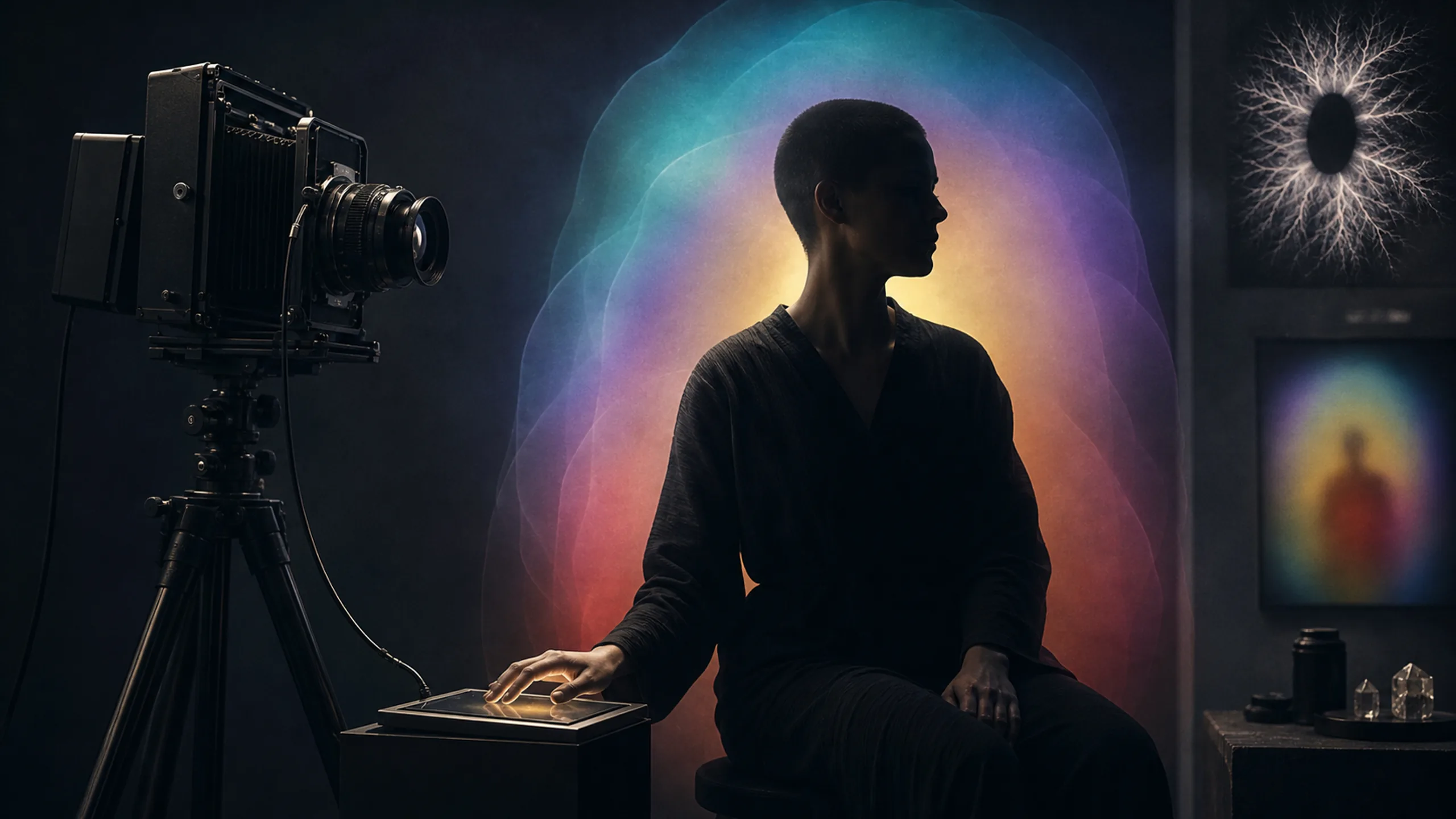
The short answer: an aura portrait is a created image
Aura photography is a modern portrait experience that surrounds a person with colored light or overlays. Depending on the system, those colors may be generated from hand sensors, skin-conductance readings, temperature, software rules, an artist's interpretation, or a combination of inputs. The finished picture can be beautiful and personally meaningful, but it is not a conventional photograph of a scientifically verified energy field.
That distinction does not make the experience fake or pointless. A portrait can function as visual storytelling: it gives a person colors through which to consider mood, presence, relationships, and attention. The responsible question is not only 'What color did I get?' but also 'How did this particular system choose it?'
Aura photographs are best treated as symbolic portraits and conversation starters—not medical images, personality tests, or proof of a permanent spiritual color.
How a modern aura camera session usually works
A studio session often begins with a seated portrait. In some systems, the sitter places one or both hands on sensor plates while a camera captures the face and upper body. Software then translates the sensor input into a colored overlay. Other experiences use a normal photo and add colors according to a questionnaire, a reader's choices, or preset visual rules.
The term 'aura camera' therefore describes a category of experiences rather than one universal measuring instrument. Two studios can photograph the same person and produce different colors because the hardware, lighting, sensor mapping, calibration, interpretation, and moment are different.
Portrait layer
A visible-light photograph records the sitter, clothing, background, pose, and studio lighting.
Input layer
Sensors, questions, photo tones, or reader choices provide signals that the system can translate.
Color layer
Software or an artist places one or more symbolic colors around or over the portrait.
Reading layer
A guide, app, or written key explains possible gifts, shadows, chakra themes, and practices.
Aura photography vs. Kirlian photography
These phrases are often blended together online, but they refer to different processes. Kirlian photography is a high-voltage contact-photography technique that records a visible corona discharge around an object placed near a photographic or recording surface. Moisture, pressure, voltage, frequency, grounding, and surrounding conditions can affect the resulting glow.
A colorful head-and-shoulders aura portrait is usually not Kirlian photography. It is more commonly a standard portrait combined with data-driven or artistic color overlays. Neither method, by itself, establishes that a spiritual field has been photographed. Clear labeling matters because the visual resemblance can otherwise make very different processes look interchangeable.
What aura photograph colors commonly mean
There is no single official aura-photography dictionary. Most contemporary readers draw from modern aura symbolism, chakra colors, color associations, and the studio's own system. Meanings should therefore be read as possibilities rather than fixed facts.
Location is sometimes interpreted as well: color near the head may be linked with thought or present attention, while color near the chest may be linked with relationship or emotion. Left-right meanings vary significantly between systems, so use the key supplied with the portrait before importing a meaning from another website.
Red, orange, and yellow
Often associated with action, embodiment, creativity, confidence, sociability, or mental activity.
Green, pink, and teal
Often read through growth, care, affection, emotional repair, boundaries, and heart-led communication.
Blue and indigo
Commonly linked with truth, listening, calm expression, pattern recognition, and inward attention.
Violet, white, and gold
Often used for imagination, meaning, spaciousness, ideals, confidence, or spiritual symbolism.
No aura color makes someone morally good, spiritually superior, dangerous, or ill. Every color can be read through both a gift and a shadow.
Why the same person can receive different aura photos
A changed portrait does not necessarily mean that something mysterious has shifted. Camera exposure, colored walls, clothing, skin contact, sensor pressure, room temperature, software settings, and the interpretive method can all change the output. A person's mood and posture may also change how they answer questions or interact with a session.
Within spiritual practice, some readers intentionally interpret an aura as a present-state image rather than a lifelong identity. That can be a healthier frame: instead of asking which portrait is the one true result, compare what each image helps you notice about its particular moment.
How an online aura scanner is different
An online aura scanner is software rather than a studio camera system. It may use questions, color choices, an optional photo, or a daily random prompt. Its strength is accessibility: a user can see the method, repeat the experience, and review the result without visiting a physical booth.
ChakraLens combines 12 reflective answers with an optional on-device photo signal. If you add a photo, broad visual qualities such as hue, lightness, warmth, and contrast are examined inside your browser; the original photo is not uploaded for the reading. The result is explicitly symbolic and is paired with chakra themes and a seven-day practice.
Physical aura camera
A studio portrait experience, sometimes using hand sensors and proprietary color mapping.
Online aura scanner
A browser or app experience that can explain its inputs and provide an immediate structured result.
Human aura reader
A person interprets perceived colors, behavior, intuition, conversation, or a generated portrait.
Try the free online aura scanner below. The photo is optional, no account is required, and the reading is for entertainment and reflection.
Open the free aura scanner online →How to prepare for an aura photo
For a physical studio, ask what the equipment records, how colors are assigned, whether your portrait or sensor data is stored, and whether you can decline marketing use. Remove the pressure to produce a special color. A calm, ordinary session is more useful than trying to perform spirituality for the camera.
For an online photo step, use a recent image in soft natural light with one person and a simple background. Avoid beauty filters, sunglasses, strong colored bulbs, screenshots, and group photos. Those choices do not make the aura more real; they simply reduce visual noise and make the method more consistent.
How to read an aura portrait without over-believing it
Begin with description before interpretation. Name the dominant color, secondary color, brightness, and where the colors appear. Then read the supplied key and identify one meaning that fits, one that does not, and one that raises a useful question. This prevents a flattering paragraph from becoming an unquestioned identity.
Finish with one observable action. Red might invite directed movement instead of urgency; green might invite receiving as well as giving; blue might invite an honest sentence and deeper listening. If the portrait makes a health, trauma, fertility, financial, or destiny claim, do not treat that claim as evidence. Seek the appropriate qualified professional where real decisions are involved.
Frequently asked
Is aura photography real?
Aura portraits are real created images, but there is no established scientific evidence that their color overlays directly photograph a spiritual energy field. They are best used as symbolic art and reflection.
How does an aura camera work?
Many aura camera systems combine a normal portrait with colors generated from hand sensors, software mappings, questions, or artistic choices. Methods vary, so ask the provider what its system actually records.
Is aura photography the same as Kirlian photography?
No. Kirlian photography records corona discharge under high-voltage contact conditions. Most colorful human aura portraits use an ordinary camera plus sensor-generated or software-generated overlays.
What should I wear for aura photography?
Follow the studio's instructions. For an online photo, neutral clothing and a simple background reduce color interference, but clothing does not reveal or change a scientifically measured aura.
Can I take an aura photo online for free?
You can use a free online aura scanner with an optional photo, including ChakraLens. The result is a symbolic interpretation rather than proof of a literal energy field.
Why did my aura photo change?
Different hardware, lighting, sensor contact, software, questions, and interpretation can change the result. Some spiritual readers also treat aura colors as a snapshot of the present rather than a permanent identity.
Sources and further reading
Create a private aura-style result online
Use 12 reflective questions and an optional on-device portrait to create your color and chakra map.
Open the free aura scanner online