Chakra Guide
अनाहत
Heart chakra meaning
Anahata · “Unstruck / Unbeaten”
Heart chakra cluster
Explore the heart chakra by question
The overview explains the center; the supporting guides separate signs, Sanskrit meaning, and practical healing so each question gets a useful answer.
Current guide
Heart chakra meaning
Start with Anahata, its symbols, location, balance spectrum, and aura link.
Signs
Heart chakra signs
Compare balanced, blocked, and overactive patterns around care and boundaries.
Opening
Heart chakra opening symptoms
Separate ordinary emotional change from chest symptoms that need ordinary care.
Location
Heart chakra location
Separate the chest focus from the physical heart and learn a one-minute attention practice.
Sanskrit + symbol
Anahata meaning
Read the Sanskrit name, pronunciation, petals, element, and modern context.
Practice
Heart chakra healing
Turn compassion, grief, receiving, and boundaries into grounded practice.
Aura bridge
Green aura meaning
See how modern green-aura language overlaps with heart-centered themes.
At the center of the seven, the heart is the bridge between earth and sky — where the body's gifts become love.
Quick answer
What is the heart chakra?
The heart chakra, also called Anahata, is commonly used as a symbolic focus for love, compassion, connection, and forgiveness.. Use its meaning as a reflection prompt, not as a medical explanation or diagnosis.
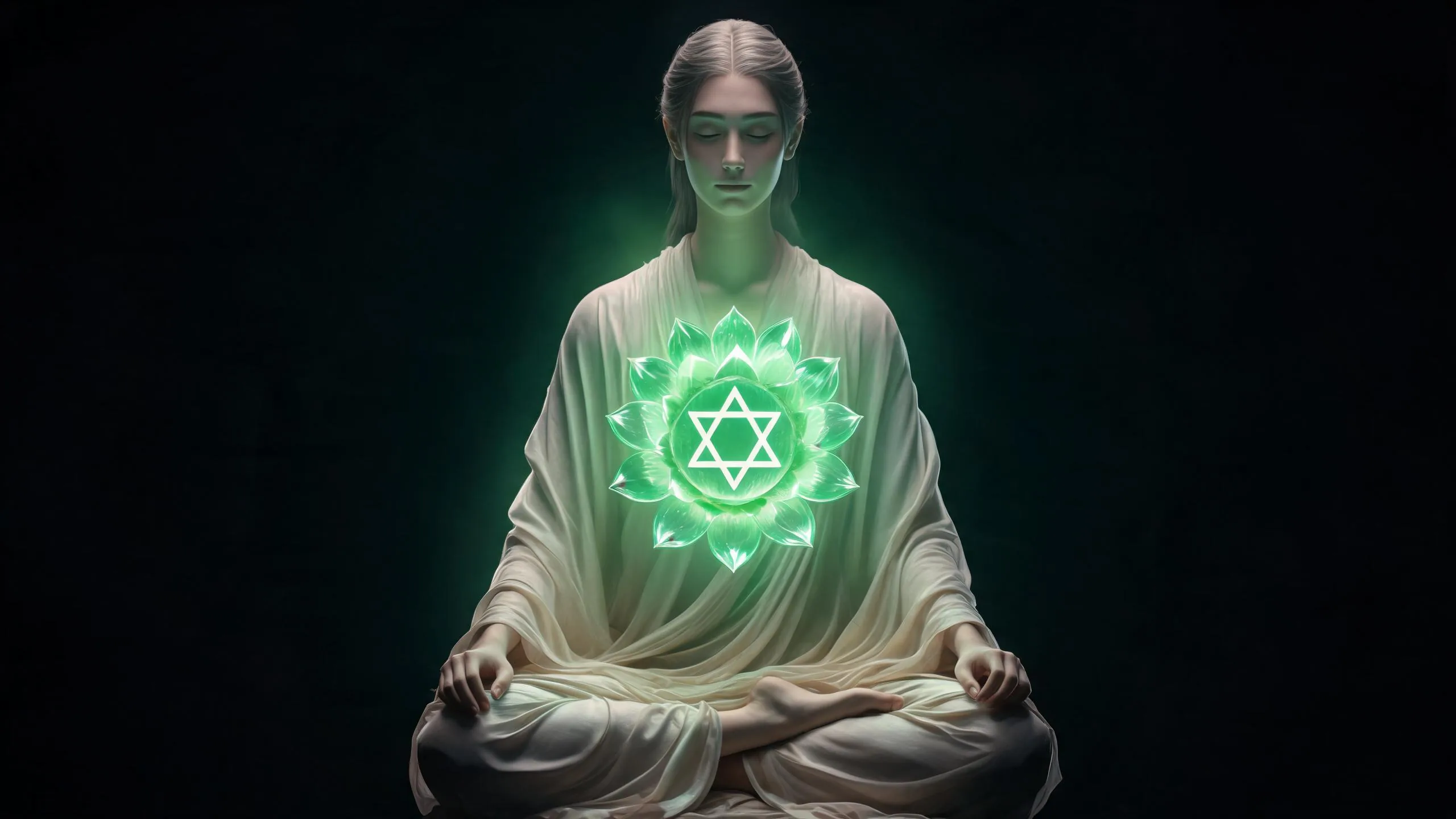
In the tantric tradition
Petals
12
Bīja mantra
Yam̐
Element
Air (Vayu)
Presiding deity
Ishana Rudra Shiva · Shakti Kakini
The 'unstruck' sound — a twelve-petalled lotus holding two interlaced triangles, the union of masculine and feminine. Element of air, ruled by Ishana Rudra. In esoteric Buddhism it is Dharma, the lotus of one's essential nature.
What the heart chakra governs
Love, compassion, connection, and forgiveness.
Heart energy is expressed through reciprocity: the ability to care without disappearing, receive without shame, grieve without closing forever, and set boundaries without making tenderness the enemy. Openness is not unlimited access; a living heart has both warmth and discernment.
Search guide
Heart chakra, Anahata meaning, symbol, and location
Heart chakra searches often mix emotional meaning with Sanskrit, symbol, and location questions. A careful reading keeps those levels distinct: Anahata is a traditional name, the chest is a meditation focus, and love is the modern reflective theme.
Meaning
The heart chakra represents love, compassion, grief, reciprocity, forgiveness, and boundaries that keep care sustainable.
Anahata
Anahata is commonly translated as unstruck, a term connected with inner or unstruck sound rather than only romance. Read more.
Symbol
Modern diagrams often show a twelve-petalled lotus and intersecting triangles; use the image as contemplative symbolism, not as anatomy. Read more.
Location
It is commonly placed at the center of the chest as an attention point for meditation and reflection. Read more.
Symbols
Compare the twelve-petalled heart symbol with the rest of the seven-center chart. Read more.
Signs
Look for the difference between warm reciprocity, guardedness, and over-giving rather than treating every difficult feeling as a block. Read more.
Opening
If the search is sudden change or chest-sensation stories, read opening language separately from blocked-sign language. Read more.
Practice
Heart work becomes concrete through receiving, repair, grief, and one honest boundary. Read more.
The balance spectrum
Chakra energy is more useful as a spectrum than a simple open-or-closed label. The same center can struggle through absence, rigidity, or excess.
Blocked
Symbolically, a blocked heart can feel walled off—connection is wanted, but trust, grief, or old hurt makes closeness difficult to tolerate.
Underactive
An underactive heart may appear as guardedness, isolation, difficulty receiving care, harsh self-judgment, or keeping relationships emotionally distant.
Balanced
You give and receive love freely, forgive without losing yourself, and feel genuine compassion for others and for yourself.
Overactive
An overactive heart may confuse love with rescue: over-giving, weak boundaries, taking responsibility for everyone’s feelings, or staying open where protection is needed.
The older “blocked” language can still be a useful metaphor: A blocked heart chakra can feel like loneliness, guardedness, difficulty trusting, or giving so much you have nothing left. It is not a medical or psychological diagnosis.
A three-minute heart chakra practice
No special object is required. Move through these three steps slowly, then carry the final action into ordinary life.
- 1Notice the movement of breath around the chest without trying to deepen it.
- 2Name one thing you can offer freely and one thing you need in return.
- 3Express either the offer or the need in one simple, honest sentence.
Other gentle ways to work with this center
- ◆Send a kind message to someone you love
- ◆Place a hand on your heart and forgive yourself
- ◆Spend a few minutes near green leaves or plants
Aura connection
Green aura & the heart chakra
Green aura symbolism and the heart chakra meet in growth, care, restoration, and connection. Their shared shadow is the empty well: tending everyone else while quietly running dry.
Read the green aura meaning →Questions for honest reflection
Use one question as a journal prompt. Specific examples are more useful than a spiritually perfect answer.
Where does compassion need a boundary to remain genuine?
What kind of care is hardest for me to receive?
Can I let grief be evidence of love rather than failure?
Chant its seed-sound
Yam̐
“I give and receive love freely, and my heart is safe to stay open.”
Frequently asked about the heart chakra
What does the heart chakra symbolize?
The heart chakra symbolizes love, compassion, grief, forgiveness, reciprocity, and the bridge between personal needs and connection with others.
What does Anahata mean?
Anahata is often translated as unstruck, referring to an inner or unstruck sound in Sanskrit contemplative language. The modern heart-chakra meaning of love and compassion is a later reflective application of this richer term.
Where is the heart chakra located?
Modern chakra practice commonly places the heart chakra at the center of the chest. Treat that as a meditation focus or symbolic location, not as a medical structure.
Is an open heart chakra the same as having no boundaries?
No. Healthy openness includes discernment and the ability to say no. Over-giving and self-abandonment may be described as overactive rather than balanced heart energy.
What is a gentle heart chakra practice?
Try naming one honest need, receiving a kindness without minimizing it, offering care you can give freely, or breathing quietly with attention at the chest.
What does Anahata mean?
Anahata is commonly translated as unstruck. In modern chakra language, it is linked with love, compassion, grief, reciprocity, and sustainable care.
Where is the heart chakra located?
Modern practice usually places the heart chakra at the center of the chest as a meditation and reflection point, not as a medical structure.
What are heart chakra signs?
Balanced signs can include warmth, reciprocity, compassion, and clear boundaries. Blocked or strained signs can include guardedness, resentment, over-giving, or fear of receiving.
What is the heart chakra symbol?
Modern diagrams usually show a twelve-petalled lotus with intersecting triangles. The image is contemplative symbolism, not a medical diagram of the heart.
What color is the heart chakra?
Modern charts usually assign green to the heart chakra. Green and pink aura language often overlaps with the same care, grief, and boundary themes.
What are heart chakra opening symptoms?
Symbolic signs can include more ease with care, grief, receiving, or a clearer boundary. Chest pain, panic, or breathlessness should not be explained away as spiritual opening.
Is Anahat the same as Anahata?
Yes. Anahat is a common spelling in some Indian languages; Anahata is the usual Sanskrit form used in English chakra guides.
How is your heart chakra expressing today?
Take the free reading to see all seven centers across the full spectrum—blocked, underactive, balanced, or overactive—with a gentle seven-day plan.
Free aura scanMore heart chakra guides
Heart chakra location
See where Anahata is placed and how that differs from the physical heart.
Heart chakra signs
Compare balanced, blocked, and overactive Anahata patterns.
Anahata meaning
Read the Sanskrit context behind the heart chakra name.
Heart chakra healing
Explore compassion, grief, boundaries, and sustainable care.
Heart chakra opening symptoms
Read opening language without spiritualizing chest pain or panic.