Chakra Guide
मूलाधार
Root chakra meaning
Muladhara · “Root / Foundation”
Root chakra cluster
Explore the root chakra by question
Use the overview for the map, then choose location, grounding practice, or a wider blocked-chakra comparison based on your intent.
Current guide
Root chakra meaning
Start with Muladhara, location, symbols, signs, and the balance spectrum.
Location
Root chakra location
Separate symbolic body mapping from anatomy and learn practical grounding cues.
Practice
Root chakra healing
Work with food, rest, routine, home, resources, and steady support.
Compare
Blocked chakras
Tell underactive, blocked, balanced, and overactive language apart.
Aura bridge
Red aura meaning
See how modern red-aura symbolism connects with grounding and embodiment.
Before the soul can soar, it must first feel safe. The root is where you meet the earth — the ground beneath every other gift you carry.
Quick answer
What is the root chakra?
The root chakra, also called Muladhara, is commonly used as a symbolic focus for safety, stability, survival, and your sense of belonging.. Use its meaning as a reflection prompt, not as a medical explanation or diagnosis.
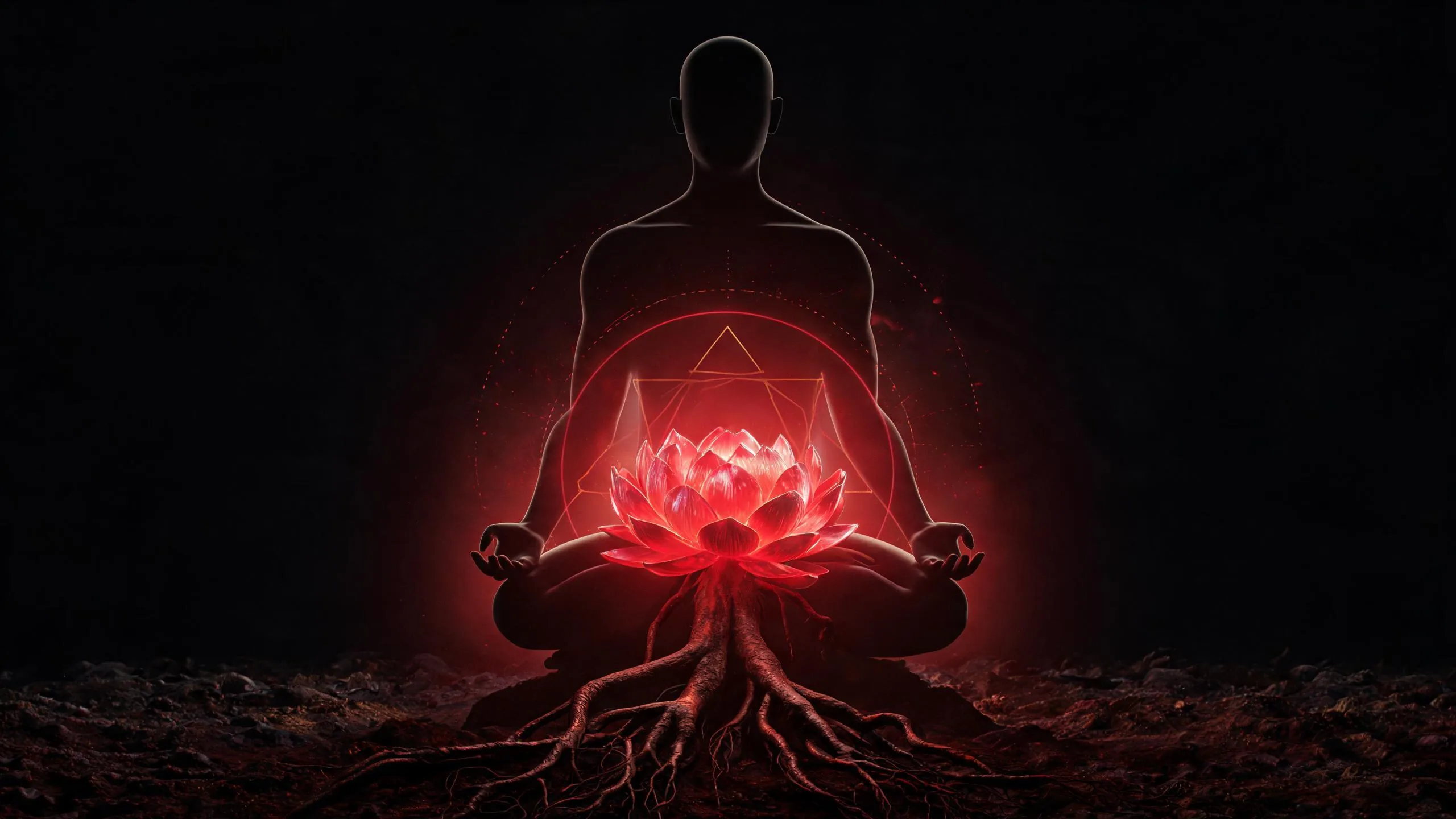
In the tantric tradition
Petals
4
Bīja mantra
Lam̐
Element
Earth (Prithvi)
Presiding deity
Ganesha · Shakti Dakini
The four-petalled lotus at the base of the spine, where the sleeping Kundalini lies coiled three and a half times around the svayambhu linga. Here rests every sound and mantra in its dormant form, guarded by Ganesha, remover of obstacles. Its element is earth; its animal, the elephant.
What the root chakra governs
Safety, stability, survival, and your sense of belonging.
Root energy is visible in the unglamorous structures that hold a life together: sleep, food, money, home, routine, physical space, and the people you can call when things go wrong. It is less about feeling calm every moment than knowing how to return to steadiness after disruption.
Search guide
Root chakra meaning, location, and base-chakra language
People often search for root chakra, base chakra, Muladhara root, or root chakra location and mean the same general center. The useful question is not whether the location is anatomically exact, but what kind of support this symbol helps you notice.
Meaning
The root chakra represents safety, belonging, body presence, basic support, home, money stress, routine, and the foundations of daily life.
Location
Modern practice places it at the base of the spine or pelvic floor and often includes the legs and feet as grounding references. Read more.
Symbol
The root chakra symbol commonly combines a four-petalled lotus, an earth square, a downward-pointing triangle, and the seed syllable LAM. Read more.
Sanskrit
Muladhara can be understood as root-support: a symbolic foundation for the rest of the chakra map. Read more.
Practice
Do one ordinary stabilizing action: eat, sleep, tidy one area, check a practical resource, or ask for concrete help. Read more.
Compare
If the word blocked feels too broad, compare it with underactive, balanced, and overactive chakra patterns. Read more.
The balance spectrum
Chakra energy is more useful as a spectrum than a simple open-or-closed label. The same center can struggle through absence, rigidity, or excess.
Blocked
Symbolically, a blocked root can feel like having no ground at all—persistent instability, disconnection from the body, or difficulty believing that support is available.
Underactive
An underactive root may show up as drifting, inconsistent routines, avoidance of practical details, or feeling present everywhere except in your own body.
Balanced
You feel grounded, safe, and at home in your body and your life. Money, health, and basic needs feel manageable, and you face change without panic.
Overactive
An overactive root may cling to certainty: rigid routines, resistance to change, over-identification with possessions, or trying to control every risk before moving.
The older “blocked” language can still be a useful metaphor: A blocked root chakra shows up as anxiety, restlessness, financial fear, or a chronic sense of not being safe or settled. You may feel disconnected from your body. It is not a medical or psychological diagnosis.
A three-minute root chakra practice
No special object is required. Move through these three steps slowly, then carry the final action into ordinary life.
- 1Name five things in the room and feel both feet meet the floor.
- 2Choose one practical task that would make the next 24 hours more stable.
- 3Complete that task slowly, letting the ordinary action be the ritual.
Other gentle ways to work with this center
- ◆Walk barefoot on the earth for 5 minutes
- ◆Eat a grounding red food and savor it slowly
- ◆Stand tall and take 10 slow, deep belly breaths
Aura connection
Red aura & the root chakra
Red aura symbolism shares the root chakra’s themes of vitality, embodiment, courage, and survival. Both carry fire and earth energy, but red also asks whether strength is grounded or constantly braced for battle.
Read the red aura meaning →Questions for honest reflection
Use one question as a journal prompt. Specific examples are more useful than a spiritually perfect answer.
What genuinely helps me feel supported—not merely distracted?
Which practical need have I been treating as spiritually unimportant?
Where would a little structure create freedom rather than restriction?
Chant its seed-sound
Lam̐
“I am safe. I am here. The earth holds me, and I belong.”
Frequently asked about the root chakra
What does the root chakra represent?
In the modern seven-chakra system, the root represents safety, belonging, stability, embodiment, and the foundations of daily life.
Where is the root chakra located?
Modern chakra practice commonly places the root chakra at the base of the spine or pelvic floor, with practical attention also extending into the legs and feet. This is symbolic subtle-body language, not established anatomy.
Is the root chakra the same as the base chakra?
Yes. Root chakra and base chakra usually refer to the same center, Muladhara, the foundational chakra associated with grounding, safety, support, and belonging.
How can I work with root chakra energy?
Try practical grounding: regular meals and sleep, time outdoors, feeling your feet, tidying one area, reviewing finances, or asking for concrete support. These are reflective practices, not medical treatments.
Is anxiety always a blocked root chakra?
No. Anxiety has many possible causes and deserves appropriate support. Root-chakra language may offer a metaphor for instability, but it cannot diagnose or explain a mental-health condition.
What is the root chakra in simple terms?
The root chakra, or Muladhara, is a symbolic center for safety, body presence, belonging, routine, money stress, home, and practical support.
Where is the root chakra located?
Modern practice usually places the root chakra at the base of the spine or pelvic floor, often including the legs and feet as grounding references.
What are common root chakra blocked signs?
Symbolic signs include feeling scattered, unsafe, unsupported, stuck in survival mode, or disconnected from the body. These are reflection prompts, not medical diagnoses.
What is the root chakra symbol?
Modern depictions of the Muladhara or root chakra commonly combine a four-petalled lotus, a square for the earth element, a downward-pointing triangle, and the seed syllable LAM.
How do I open or unblock the root chakra?
Use one ordinary stabilizing action: eat, rest, feel your feet, tidy one surface, or ask for practical support. There is no verified medical procedure for opening a chakra.
How is your root chakra expressing today?
Take the free reading to see all seven centers across the full spectrum—blocked, underactive, balanced, or overactive—with a gentle seven-day plan.
Aura scanner from a photo