Seven Chakra Colors
The seven chakra colors: meanings, order, and modern symbolism
A practical guide to the red-to-violet chakra color system, what each color represents, and why the familiar rainbow chart is a modern map rather than a universal ancient rule.
Sanskrit source cluster
Follow the chakra terms back to their context
Use the name chart as a reference, then separate primary-text history, lotus iconography, subtle channels, and the modern rainbow system instead of treating them as one timeless map.
Reference
7 chakra names in Sanskrit
Compare Devanagari, IAST, literal meanings, word roots, and pronunciation in one table.
Primary text
Shat Chakra Nirupana
Meet the influential Sanskrit text behind many modern six-center and crown descriptions.
Iconography
Lotus petals and bija mantras
Decode the petal counts, Sanskrit letters, and seed sounds used in traditional diagrams.
Channels
Ida, Pingala, and Sushumna
Read the three subtle channels with transliteration, source context, and careful modern caveats.
Current guide
7 chakra colors
See why the familiar red-to-violet chart is useful today but not a universal ancient scheme.
The chakra rainbow at a glance
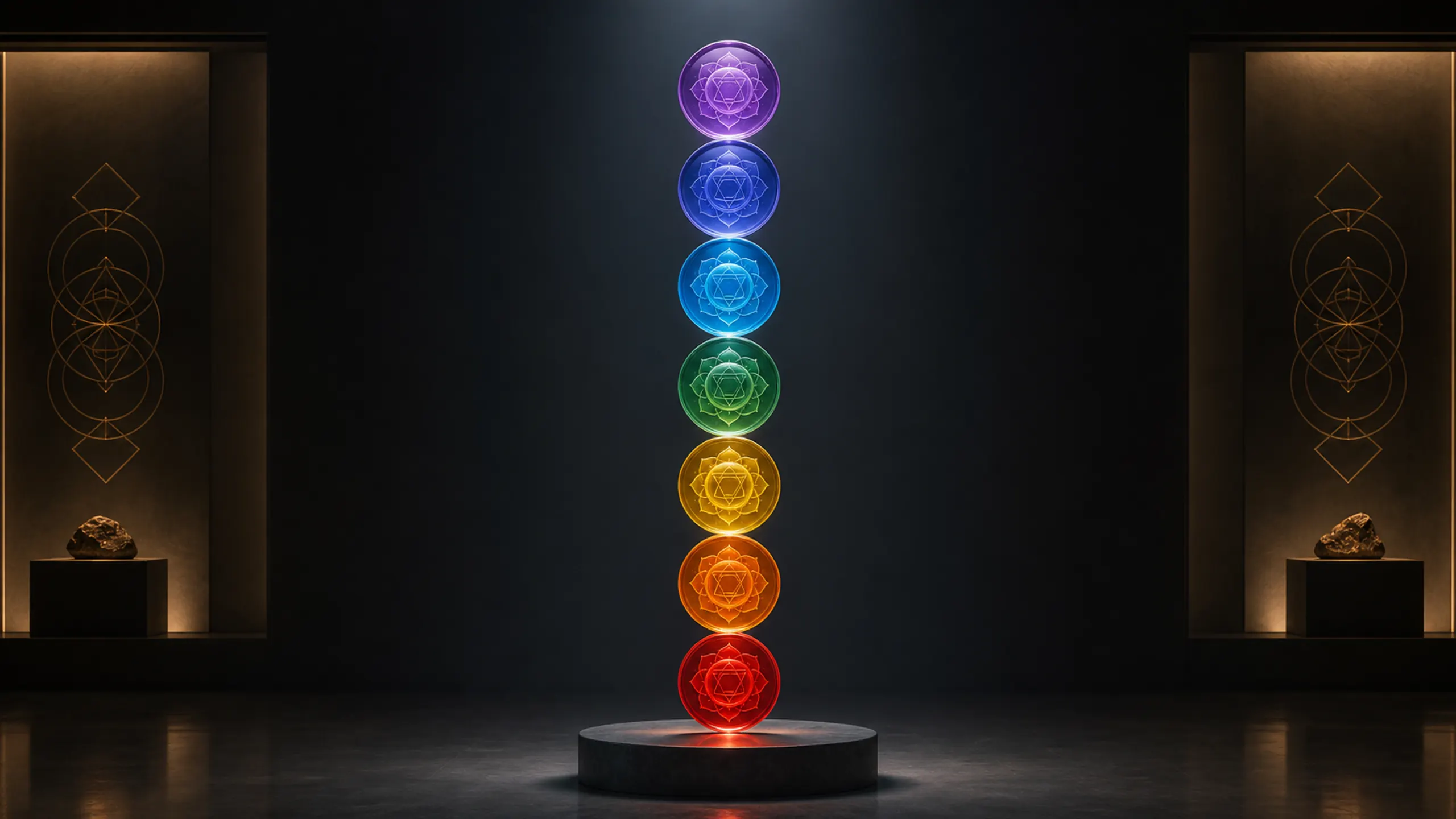
The most familiar modern chart places seven chakras along the central axis of the body: red at the root, orange at the sacral center, yellow at the solar plexus, green at the heart, blue at the throat, indigo at the brow, and violet or white at the crown.
This sequence is memorable because it rises through the visible rainbow while moving from themes of survival and embodiment toward expression, insight, and meaning. It is widely used in contemporary yoga, wellness, and New Age practice, but it should not be mistaken for the only chakra system found across Hindu and Buddhist traditions.
Traditional subtle-body systems vary in the number, location, imagery, and color of chakras. The fixed seven-color rainbow is best understood as a modern teaching framework.
Red, orange, and yellow: the lower three centers
The lower colors are commonly associated with being embodied in ordinary life: safety, desire, movement, identity, and agency. They are not “less spiritual.” A practice that reaches upward without grounding can become detached from daily needs and responsibilities.
Red · Root · Muladhara
Grounding, belonging, stability, and the right to exist. Its element is commonly described as earth.
Orange · Sacral · Svadhisthana
Feeling, pleasure, creativity, relationship, and flow. Its element is commonly described as water.
Yellow · Solar Plexus · Manipura
Confidence, choice, boundaries, and purposeful action. Its element is commonly described as fire.
Green and blue: connection becomes expression
At the center of the modern seven-chakra map, green acts as a bridge between the lower and upper centers. Blue then gives relationship and feeling a voice. Together they ask two different questions: can I remain open, and can I express what is true without abandoning connection?
Green · Heart · Anahata
Love, compassion, grief, reciprocity, and boundaries. Its element is commonly described as air.
Blue · Throat · Vishuddha
Truth, listening, communication, and creative expression. Its element is often described as ether or space.
Indigo and violet: insight and meaning
The upper colors are often framed as inner sight and connection to something larger. Their shadow is not darkness but imbalance: intuition without reality-checking, or spiritual ideals that become an escape from the body and the practical world.
Indigo · Third Eye · Ajna
Discernment, imagination, pattern recognition, and the conversation between intuition and reason.
Violet or white · Crown · Sahasrara
Meaning, unity, humility, wonder, and relationship to the sacred or transcendent.
How to use chakra colors without becoming rigid
Use color as an attention cue. Wear it, visualize it, place it in a journal, or use it to remember a theme during meditation. There is no need to buy a particular crystal, oil, or product, and there is no evidence that a color can diagnose or cure a medical condition.
If a color association does not resonate, return to the underlying quality. You may connect grounding with brown rather than red, or spiritual openness with clear light rather than violet. A symbolic system should support awareness, not demand obedience.
Morning
Choose one chakra quality you want to practice and use its color as a reminder.
During the day
Notice when the quality appears naturally rather than forcing a mystical experience.
Evening
Write one example of balance and one place where the theme felt difficult.
Save for later
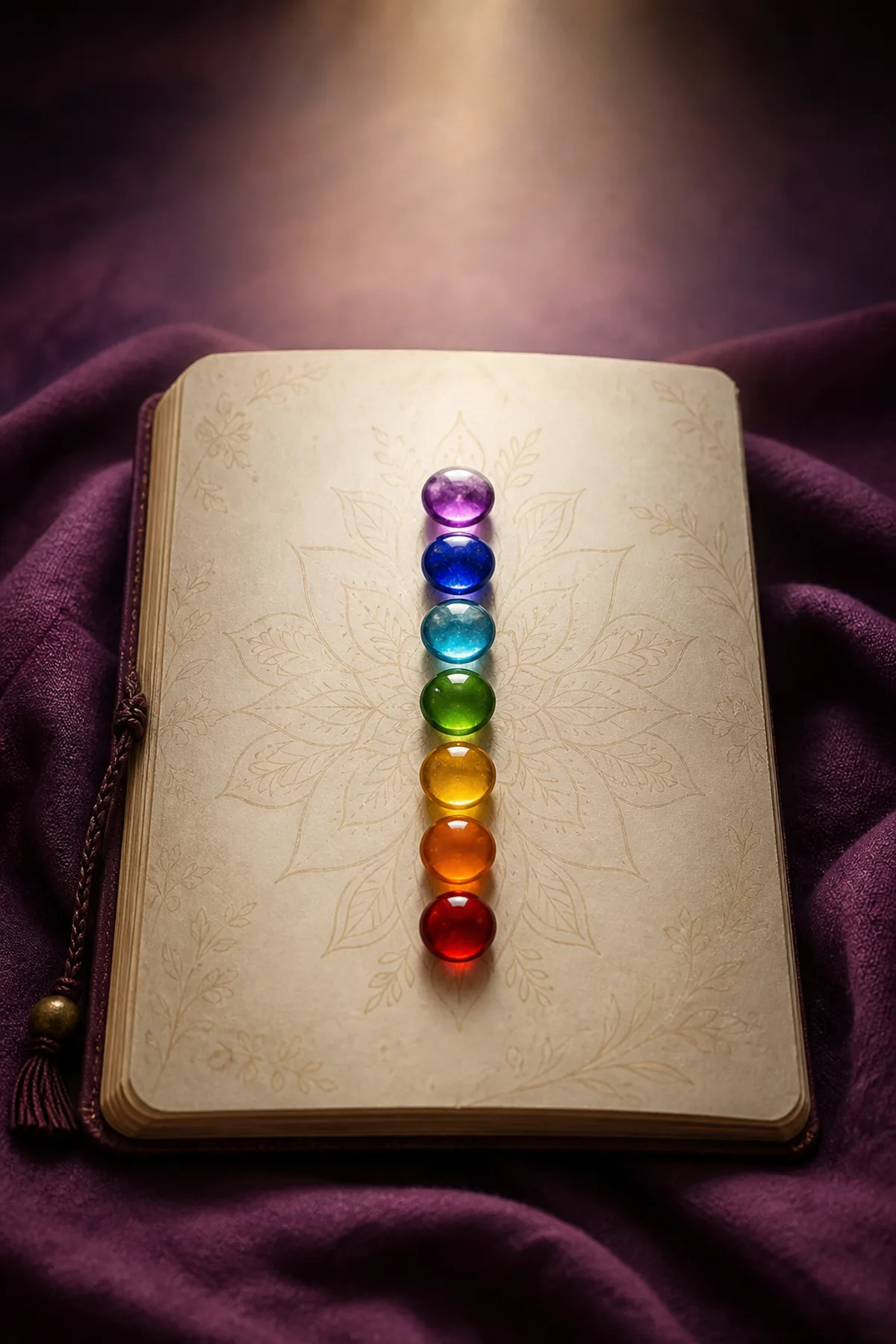
Save the 7 chakra colors chart
A vertical visual reference designed for a journal board or Pinterest. The full guide stays linked so the image is never separated from its context.
Frequently asked
What are the seven chakra colors in order?
From root to crown, the familiar modern sequence is red, orange, yellow, green, blue, indigo, and violet or white.
Are chakra colors ancient?
Color symbolism appears in traditional subtle-body systems, but the fixed red-to-violet rainbow chart is a modern synthesis. Historical traditions use varied numbers, images, and colors.
Is a chakra color the same as an aura color?
No. Chakra colors are usually assigned to specific centers, while aura colors are interpreted as qualities of a surrounding field or overall presence. Modern readings often connect the two.
Sources and further reading
Turn the guide into a personal reflection
Answer 12 reflective questions for a free aura and chakra reading. No sign-up; photo optional and processed privately on your device.
Begin my reading