Tantric Text Guide
Shat Chakra Nirupana: the text behind the six centers
A source-aware guide to Ṣaṭcakranirūpaṇa (Shat Chakra Nirupana): its author, six bodily centers, Sahasrara, Kundalini, lotus symbolism, and its difference from the modern rainbow chakra chart.
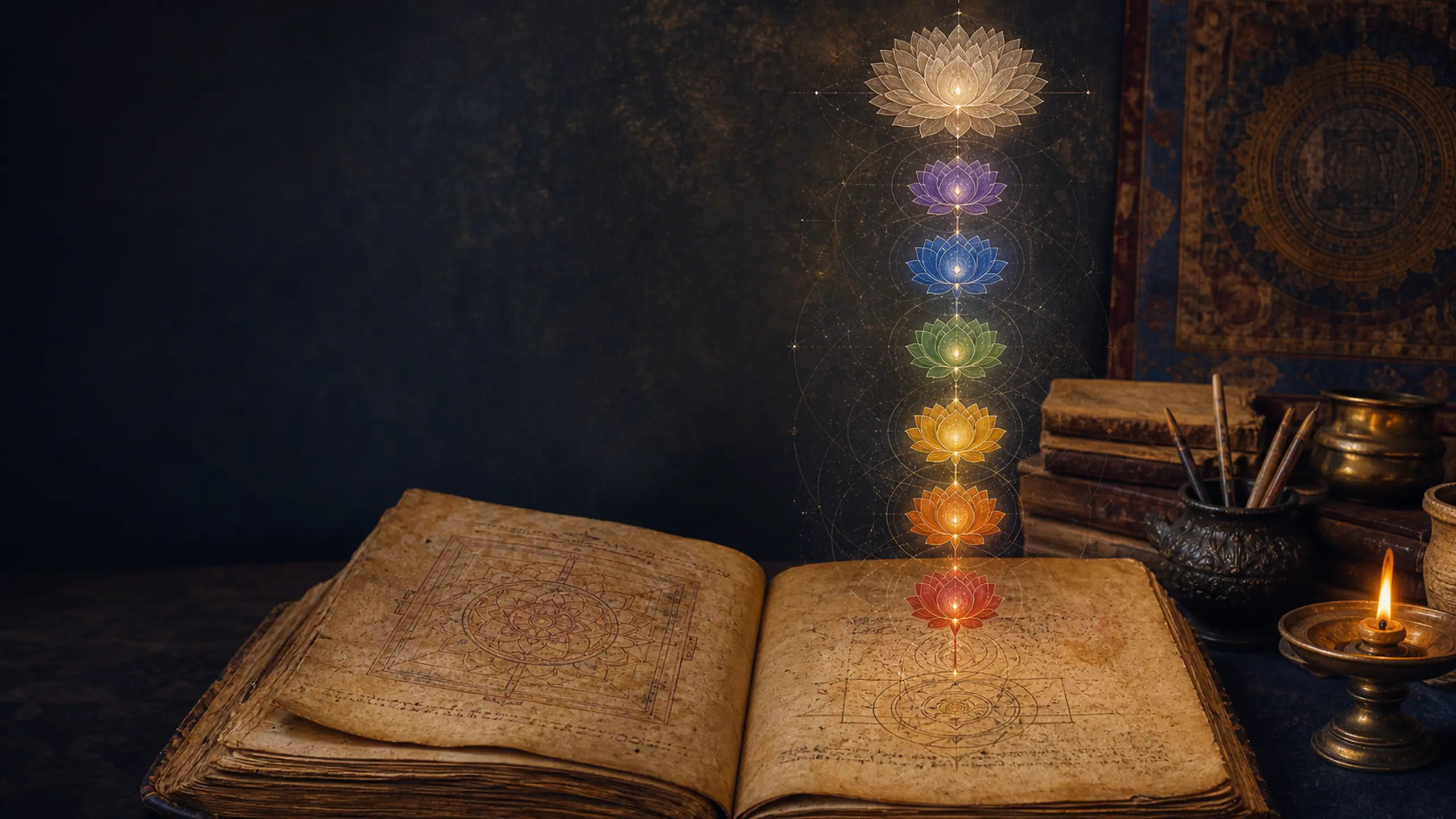
Sanskrit source cluster
Follow the chakra terms back to their context
Use the name chart as a reference, then separate primary-text history, lotus iconography, subtle channels, and the modern rainbow system instead of treating them as one timeless map.
Reference
7 chakra names in Sanskrit
Compare Devanagari, IAST, literal meanings, word roots, and pronunciation in one table.
Current guide
Shat Chakra Nirupana
Meet the influential Sanskrit text behind many modern six-center and crown descriptions.
Iconography
Lotus petals and bija mantras
Decode the petal counts, Sanskrit letters, and seed sounds used in traditional diagrams.
Channels
Ida, Pingala, and Sushumna
Read the three subtle channels with transliteration, source context, and careful modern caveats.
Modern comparison
7 chakra colors
See why the familiar red-to-violet chart is useful today but not a universal ancient scheme.
The short answer
Ṣaṭcakranirūpaṇa—often written Shat Chakra Nirupana, Sat Chakra Nirupana, or Ṣaṭcakra-nirūpaṇa—means “description of the six chakras” or “six centers.” It is a Sanskrit tantric yoga text associated with Pūrṇānanda, who was active in the sixteenth century. The work is commonly treated as the sixth chapter of the Śrītattvacintāmaṇi.
It matters because it gives a detailed map of Muladhara, Svadhisthana, Manipura, Anahata, Vishuddha, and Ajna: their lotuses, petals, seed syllables, deities, elements, and relationship to subtle channels. It also describes Sahasrara above the six centers. That “six plus what is above them” structure is one reason the text should not be flattened into a modern seven-color infographic.
This is a guide to a historical tantric text and its later reception. It is not a medical map, a claim that chakras are physical organs, or instructions to force a Kundalini experience.
Why is it called six chakras if many people learn seven?
The title is precise: ṣaṭ means six, cakra means wheel or center, and nirūpaṇa means description or exposition. The text describes six primary bodily centers along the subtle axis: Muladhara, Svadhisthana, Manipura, Anahata, Vishuddha, and Ajna.
Sahasrara, the thousand-petalled lotus at the crown, is also important in the text, but it is described above the six bodily centers rather than simply being counted as a seventh item in the title. Modern teaching often groups it with the six to make a seven-chakra ladder. That convention can be useful for beginners, but it is a later simplification rather than the only historically meaningful count.
Six centers in the title
Muladhara, Svadhisthana, Manipura, Anahata, Vishuddha, and Ajna are the six named centers that organize the exposition.
Sahasrara above
The thousand-petalled lotus is described above them and is central to the work's contemplative horizon.
Modern seven-chakra chart
A practical global-yoga teaching format that usually counts Sahasrara as the seventh chakra and assigns a fixed rainbow sequence.
The six centers at a glance
The text is denser than a list of personality traits. Each center is imagined through a lotus, a number of petals, syllables, geometries, elemental regions, divine forms, and practices. The following list is only a reading orientation—not a substitute for the verses and commentaries.
Muladhara
The foundational center, often associated in modern language with grounding. The text uses a four-petalled lotus and the seed syllable Laṃ.
Svadhisthana
The six-petalled center associated with a watery region and the seed syllable Vaṃ.
Manipura
The ten-petalled “city of jewels,” associated with a fiery region and the seed syllable Raṃ.
Anahata
The twelve-petalled “unstruck” center, associated with air and the seed syllable Yaṃ.
Vishuddha
The sixteen-petalled center, commonly translated as especially pure, associated with space and the seed syllable Haṃ.
Ajna
The two-petalled command center at the brow, whose imagery is not reducible to the contemporary phrase “third eye.”
Sahasrara
The thousand-petalled lotus above the six, associated with the text's highest contemplative imagery rather than a routine personality category.
Nadis, Kundalini, and the central path
The map is inseparable from subtle channels, or nadis. Early verses describe Sushumna in the middle, with additional subtle channels named within or alongside it in the commentary tradition. This is not an anatomical claim about the spinal cord. It is a yogic and tantric visualization framework with its own vocabulary and ritual logic.
Kundalini is described through powerful symbolic language, including a coiled sleeping force at the base. In the text, its ascent belongs to a disciplined soteriological path involving mantra, meditation, guru-oriented instruction, and subtle-body practice. Treating it as a guaranteed wellness hack, a symptom checklist, or an achievement to trigger on demand loses the text's context and can encourage unsafe practice.
Lotus petals, seed syllables, and why details matter
A modern chakra card may say “heart = green = love.” Ṣaṭcakranirūpaṇa is far more specific. Its centers have petal counts, Sanskrit letters, geometric forms, deities, Śaktis, elements, sounds, and relationships with other tantric ideas. These details are not decorative extras; they make the centers part of a ritual and contemplative cosmos.
That is also why modern correspondence charts vary. A fixed rainbow spectrum is memorable, but it is not the organizing principle of every source. If you use contemporary colors for meditation, it is more honest to call them a modern practice language than to imply that every ancient text used the same palette in the same way.
For a practical modern chart, see the seven chakra colors guide. For historical terms, let the original textual tradition remain more complex than the chart.
How this text reached modern chakra culture
The work became especially influential for English-speaking readers through early twentieth-century publication and translation associated with Arthur Avalon, the pen name of Sir John Woodroffe. Those editions introduced a wide audience to a highly detailed tantric chakra map, but they also reflect their own editorial and interpretive moment.
Modern yoga, New Age spirituality, wellness publishing, color systems, and online quizzes subsequently blended elements from multiple traditions into the familiar seven-chakra model. That modern model can be meaningful to practitioners, but it should not be mistaken for a complete or unchanged reproduction of one sixteenth-century Sanskrit work.
What Shat Chakra Nirupana does not establish
The text does not establish that chakras can diagnose disease, predict personality with certainty, reveal moral worth, or replace a clinician, therapist, or financial adviser. A spiritual or historical source can be culturally important without becoming scientific evidence for medical claims.
It also does not prove that there is one universal chakra count. South Asian tantric and yogic traditions contain multiple subtle-body maps. The useful scholarly habit is to ask: which text, which lineage, which period, and which practice context is being discussed?
A respectful way to study it
Start by reading a reliable edition or translation alongside a source-aware guide. Notice what the verse actually describes before translating it into a personal trait. Compare more than one source where possible, because transliteration, dating, editions, and commentary can differ.
If you practice, keep the practice modest: a short seated meditation, a relevant verse or name, and attention to how a symbolic theme appears in ordinary life. Stop if breathwork, visualization, or inward focus causes distress. For physical or mental-health symptoms, use qualified professional support rather than reinterpreting them as proof of chakra activation.
Frequently asked
What does Shat Chakra Nirupana mean?
Ṣaṭcakranirūpaṇa means “description of the six chakras” or “six centers.” It is a Sanskrit tantric yoga work associated with Pūrṇānanda.
Who wrote Shat Chakra Nirupana?
The text is associated with Pūrṇānanda, who is catalogued by Wellcome Collection as active 1526–1577. It is commonly treated as part of the Śrītattvacintāmaṇi.
Why does the text say six chakras?
It describes six bodily centers—Muladhara through Ajna—while also describing Sahasrara above them. Modern seven-chakra teaching commonly counts Sahasrara as the seventh.
Is Shat Chakra Nirupana the source of the rainbow chakra colors?
Not in the simple modern poster sense. The text has rich symbolic imagery, but the fixed red-to-violet teaching sequence is a modern synthesis shaped by later global yoga and esoteric culture.
Is the text safe to use for Kundalini activation?
It is best studied with context rather than used as a self-directed activation manual. Intense breathwork or altered-state practices can be destabilizing for some people; grounded, moderate practice and qualified guidance are safer.
Where can I read Shat Chakra Nirupana?
Wellcome Collection catalogs a Sanskrit edition, and WisdomLib provides a public English translation attributed to Arthur Avalon. Read translations critically and compare editions where possible.
Sources and further reading
- Wellcome Collection: Sanskrit edition of Shatchakra-nirūpana
- WisdomLib: public English translation and verse index
- SOAS Haṭha Yoga Project: research on yoga texts and practice history
- Seven chakras: names, order, colors, and body map
- Chakra names in Sanskrit
- Chakra colors: modern chart and historical context
- Kundalini and the seven chakras
Turn the guide into a personal reflection
Answer 12 reflective questions for a free aura and chakra reading. No sign-up; photo optional and processed privately on your device.
Begin my reading